“Nuclear-gauge density on the binder course hit target on the second breakdown pass — we stopped over-rolling and cut fuel burn on the night shift.”
Highway Base Course · Hot-Mix Asphalt
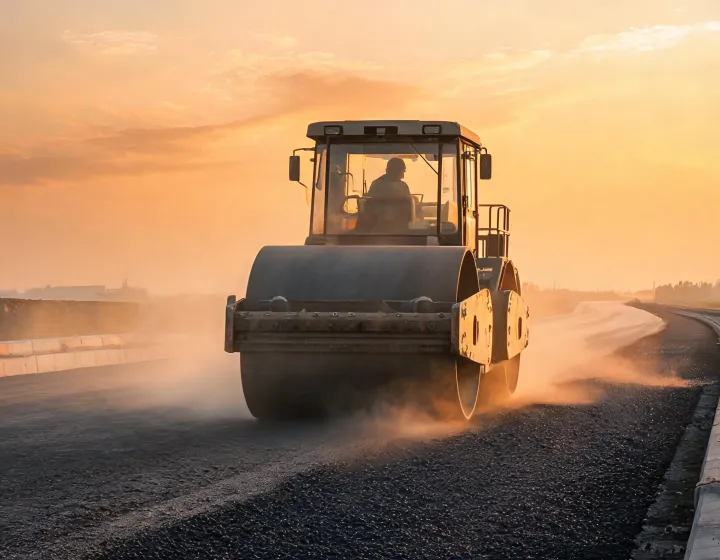
Road Rollers & Asphalt Compactors Built for Density You Can Measure
Tell us your lift thickness, mat width and daily tonnage — Bomag application engineers match a vibratory roller train that hits nuclear-gauge targets without over-rolling the wearing course.
- Static line load up to 33 kg/cm on tandem drums
- Dual amplitude 0.4 / 0.8 mm · 50 / 60 Hz
- Emissions EPA Tier 4 Final / EU Stage V
FAQ by Paving Workflow
Straight answers procurement managers and equipment supervisors ask before locking a roller train purchase order.
Asphalt Compaction
What roller sequence densifies a 50 mm hot-mix wearing course?
Start with a double-drum vibratory roller for breakdown while the mat stays above 140°C, follow with a pneumatic tire roller for kneading seal, then finish static on the tandem drums. Keep the breakdown unit within 15–30 m of the paver screed so amplitude work happens before the mix stiffens.
How do I choose amplitude for base course versus wearing course?
Use the higher amplitude setting (around 0.8 mm) on granular base and binder courses where deeper particle rearrangement is needed. Drop to 0.4 mm or static finish on thin wearing courses to avoid aggregate crushing and surface checking.
Equipment Selection
When is a pneumatic tire roller mandatory on the train?
Specify a pneumatic tire roller whenever the specification calls for sealed surface texture, airport pavement, or SMA mixes. The overlapping tires compact from the top down and close surface voids that tandem steel drums alone leave open.
What drum width covers a 3.75 m lane efficiently?
A 2.0 m drum typically finishes the lane in two overlapped passes; a 1.5 m drum needs three. Edge zones within 150 mm of curb usually need a smaller tandem or plate compactor so the main roller never rides the drainage structure.
Compliance & Lead Time
Do Bomag rollers ship EPA Tier 4 Final / EU Stage V?
Yes. Current production road rollers and pavers leave the plant with Tier 4 Final / Stage V aftertreatment. We issue NOx and PM logs per machine serial number for bid packages that require emission evidence.
What is the typical PO-to-commissioning window?
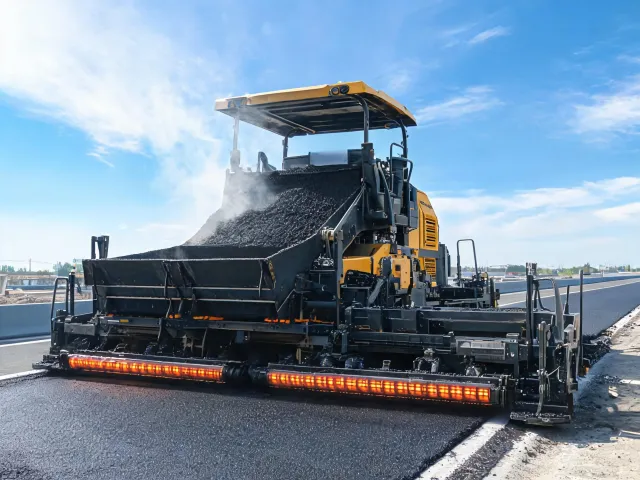
Standard tandem rollers ship in 10–14 weeks ex-works; asphalt pavers with electric-heat screeds run 14–18 weeks including foundation and trailer review. On-site commissioning and operator familiarization are scheduled inside the first paving week.
Aftermarket Parts
How often should vibration bearings be inspected?
Inspect eccentric-shaft bearings and amplitude shift mechanisms every 500 hours, or sooner when isolator temperatures spike. We stock drum shells, scrapers and isolators at regional hubs so mid-season rebuilds do not idle the paving train.
Paving-Train Spec Points That Keep Gauge Readings Honest
- ✓ Dual-amplitude vibratory system with 50 / 60 Hz frequency lock
- ✓ Drum widths from 1.5 m to 2.13 m for lane and shoulder work
- ✓ Cab noise held under ISO 6395 site limits for night paving
- ✓ Hydraulic cleanliness targeted to ISO 4406 18/16/13 at ship
- ✓ EPA Tier 4 Final / EU Stage V engines with serial emission logs
- ✓ On-site commissioning plus operator amplitude training included
Double-Drum Vibratory Roller — Engineering Spec
Expand each group for the numbers fleet managers put into bid comparisons. Values shown are representative of our mid-class tandem line; final quotes follow your mat design.
Drum & Compaction Geometry
| Operating mass | 10 – 14 t class options |
|---|---|
| Drum width | 1,680 – 2,130 mm |
| Static linear load | 28 – 33 kg/cm |
| Amplitude | 0.4 mm / 0.8 mm dual |
| Frequency | 50 / 60 Hz selectable |
Powertrain & Emissions
| Engine rating | 75 – 110 kW class |
|---|---|
| Emission stage | EPA Tier 4 Final / EU Stage V |
| Fuel strategy | DPF + SCR aftertreatment |
| Travel speed | Up to 12 km/h working / transport |
Operator Cab & Safety
| Cab noise | ISO 6395 compliant target < 75 dB |
|---|---|
| Visibility | 360° drum-edge sight lines |
| Safety package | ROPS structure, beacon, lockable isolators |
| Water system | Pressurised spray with interval control |
Service Intervals
| Daily | Scraper, spray nozzles, drum edge check |
|---|---|
| 500 h | Vibration bearing temperature survey |
| 2,000 h | Hydraulic filter and fluid lab sample |
| Field response | < 18 h MTTR on contracted paving sites |
What Paving Supervisors Report After Commissioning
Anonymous roles and contractor types only — we never publish unauthorised company names.
“The pneumatic tire roller closed the SMA surface voids that our old steel-only train left open. Airport friction tests passed on the first attempt.”
“Vibration-unit rebuild at 4,200 hours arrived from the regional hub in 36 hours. The paving train stayed on the published lane closure calendar.”
Build Your Compaction Quote in Three Steps
Project context first, machine class second, contact last — so the engineer who replies already knows your mat design.
- 1. Project
- 2. Machine
- 3. Contact
Step 1 — Project workflow
Tell us whether you are densifying highway base course, urban mill-and-fill, mining haul roads or waterworks embankments. Include country and site region so we route the right hub.
- Highway / arterial hot-mix overlay
- Mining haul-road compaction
- Urban mill-and-fill with night closures
- Waterworks or embankment soil compaction
Step 2 — Machine class
Pick the equipment class that matches your lift plan. Note fleet size on this site and whether Tier 4 Final documentation is mandatory for the bid.
- Double-drum vibratory roller (breakdown / finish)
- Pneumatic tire roller (intermediate seal)
- Asphalt paver with electric-heat screed
- Plate compactors for edge and trench work
Step 3 — Contact & submit
Share company details and any lift drawings. An application engineer replies with a roller-train recommendation inside one business day.
Density-proven rollers. Paving-day support. Serial emission logs.
From highway binder courses to mining haul roads — we ship the compaction train and stay through the first 1,000 paving hours.
Talk to an Application Engineer